

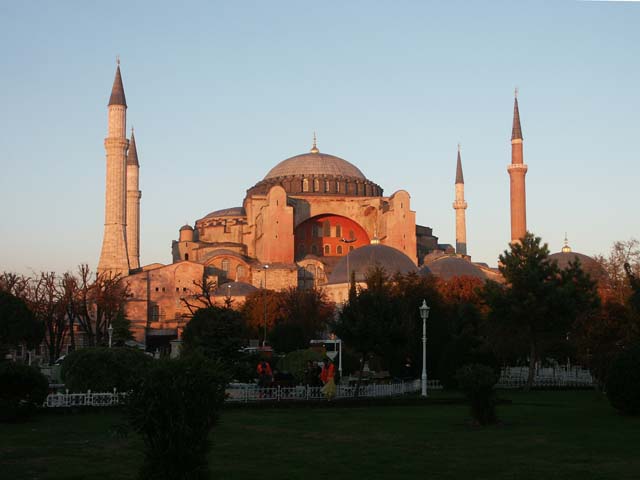
 Haghia Sophia
Constantinople
Location;. Google Maps
When the Western Roman
Empire collapsed in the 5th Century, the east, centred
on Constantinople, continued for almost 1000 years, at one point reconquering a
large part of the western empire. However in 1453 the city was conquered by the
Ottoman Sultan Mehmet. Renamed Istanbul (a Turkish corruption of "Stanpoli"; an abbreviated Greek name for
Constantinople) it was the capital of the Ottoman Empire for almost 500 years.
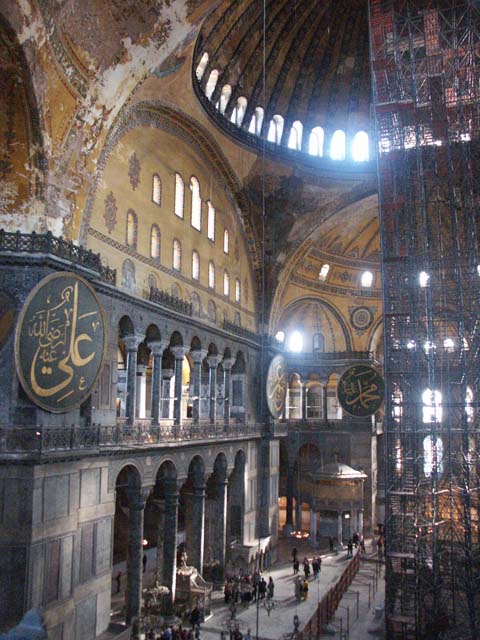 Description; While
Britain languished in the so called Dark Ages, the Constantinopolian
or Byzantine empire was enjoying a golden age. The Haghia
Sophia was built in 532AD by the emperor Justinian on the ruins of an earlier
foundation.
Description; While
Britain languished in the so called Dark Ages, the Constantinopolian
or Byzantine empire was enjoying a golden age. The Haghia
Sophia was built in 532AD by the emperor Justinian on the ruins of an earlier
foundation.
Haghia Sophia is the Greek form of The Church of The
Holy Wisdom. For many centuries it was the largest enclosed space in the world
and was the inspiration for many churches throughout Europe; San Vitale in
Ravenna, Italy and Aachen Cathedral in Germany being two examples. The minarets
and Islamic symbols were added after the Ottoman conquest and the church was
converted into a mosque. The large enclosed space was ideal for the Muslim form
of worship and therefore served as a model for subsequent mosques in Istanbul
and around the Islamic world. The building is now a museum.
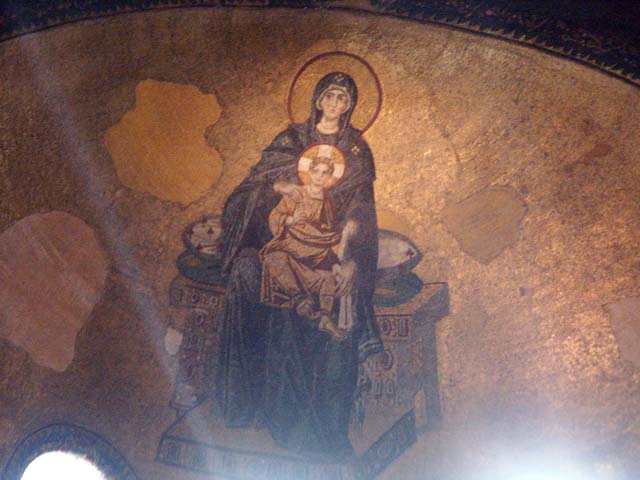
I
A high point of Byzantine
art was in mosaics. The Haghia Sophia interior was
completely covered in mosaics until the period known as the Iconoclasm, when
all forms of human & animal depiction was banned, probably a pious response
to similar customs in the emerging disciplines of Islam. However, a later
enlightenment revoked this and the mosaics were restored.
However, after the Ottoman conquest, the mosaics were again covered and
remained so throughout its life as a mosque. Later restorations have revealed
some magnificent samples.
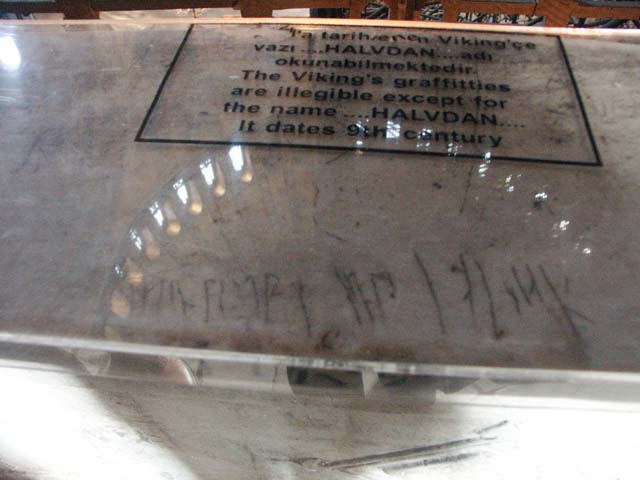
This picture
shows evidence of Vikings in Constantinople. As the protective perspex inscription shows, someone called Halvdan produced this graffiti sometime in 9th
Century. The Vikings were well known for navigating deep inland via large
rivers and dragging boats across land between rivers, so would have reached
Constantinople from the Baltic, probably entering the Black Sea via Kiev on the
River Dnieper. King Harald Hardrada
of Norway, who invaded England in 1066 and was beaten at the Battle of Stamford Bridge, is known to have spent
time in the Byzantine Imperial Guard.
All
Photographs by the author.